Vicon just bought markerless facial capture, and the integration matters
Head-mounted cameras for facial performance capture are now part of a full-body mocap pipeline. Here is what that changes.
Vicon acquired Captive Devices in September 2026. Captive Devices made head-mounted camera systems for markerless facial performance capture; Vicon runs the motion-capture arm of Oxford Metrics. The deal is small news in the trade, but the detail matters: studios like Ninja Theory, Nant Studios, Animatrik and Deep Silver Dambuster have already built facial workflows around Captive's hardware. Now those workflows plug directly into a full-body mocap system without a handoff between vendors.
This is not revolution. It is the boring work of making pipelines talk to each other. Which is exactly when they get boring, they actually start saving time.
For years, the split between body and face has been a known friction point in digital-human capture. Your body comes from a marker-based system or IMU suit; your face comes from a separate rig, usually a camera mounted to the head or a facial-marker setup bolted to a helmet. The take is good on both halves, but the moment you need to marry them, you are synchronizing timestamps, matching coordinate spaces, and hoping the frame rates line up. Studios did it. It worked. It was not elegant.
The Captive Devices cameras are markerless, which means they work from video alone. Head-mounted cameras watch the actor's face from up close, machine learning extracts facial geometry and expression in real time, and that data feeds into your character rig. No facial markers, no helmet clutter, just cameras on a headset watching what the face actually does. Studios using it have reported that the image quality of the capture is strong enough that you can feed it straight into a character rig without the usual cleanup pass that other systems need.
Vicon's acquisition means that pipeline now sits inside one software environment. If you are already using Vicon's body capture (and most major studios are, or have at some point), your facial data lands in the same coordinate space, at the same frame rate, with the same time code. No re-sync. No translate-the-data step. The actor walks out of the stage and your full digital human walk walks with them.
Vision For Xperiences watches capture pipelines because we build digital humans for commercial work, and that means we think about what the capture stage actually hands us. The difference between "I have body geometry and facial blend shapes in separate files" and "I have them in one time-locked stream" is not obvious until you are halfway through the project and realize one timeline just became two. With body and face capture integrated, the retiming work disappears.
The other piece worth noting: Vicon integrates Captive Devices' workflow into their Vicon Shogun ecosystem, which is where most studios do their real-time preview and character animation in production. That means the actor's face is visible to the director and animation team in real time as it happens on set. You see the subtle expression shift that the camera-mounted rig might have buried in tracking artifacts. You can call for another take while the setup is hot.
Captive Devices' tech was already strong before this. Studios do not usually bet on a facial-capture vendor unless the output actually works. But Vicon's reach changes the distribution story. Vicon installed base is broad; Captive's was concentrated among high-end games and film studios that had already solved the "how do we sync face and body" problem themselves. Now that problem is solved once, in the product, for everyone.
There are still catches. Markerless systems are fast but they are not immune to backlighting or extreme angles; a performer who turns their head too far can drop the track. The resolution of the capture is high for facial micro-expressions but still lower than a marker-based facial rig if you are shooting hero close-ups where every wrinkle matters. And the real-time pipeline still demands a solid setup: good lighting, good camera positions, calibration that does not drift. This is not point-and-shoot.
But the handoff friction is real, and removing it lets studios quote tighter timelines on digital-human work. If Vision For Xperiences were building a character for an installation or live experience, fewer synchronization steps means shorter production and less chance that something gets lost when one team hands files to another. That matters on deadline.
The game-industry studios already using Captive have been shipping work with this quality for a while. Now it reaches into the traditional VFX and film pipelines, where the people deciding on tools tend to move slowly. Vicon betting on facial-capture integration tells you something: the old argument about whether body and face should be separate signals is settling. They are not separate anymore.
Quick answers
Do we still need facial markers for hero close-ups?
Markerless systems like Captive work well for dialogue and expressions, but marker-based setups still capture more detail in extreme close-ups where wrinkle definition matters. Most studios use both: markerless for speed and comfort, markers for close-up shots where you need sub-millimeter precision.
Will this change how we buy mocap equipment?
If your studio already uses Vicon, you now have an on-ramp to facial capture without a separate vendor contract. For smaller studios or those just starting out, this means fewer systems to learn and integrate yourself, which can shorten the learning curve.
Does the integration work with other body mocap systems?
Vicon's integration is native to their ecosystem. Other body-capture systems (IMU suits, marker-based competitors, markerless alternatives) would need their own integration work with Captive's software to achieve the same seamless sync.
Referenced
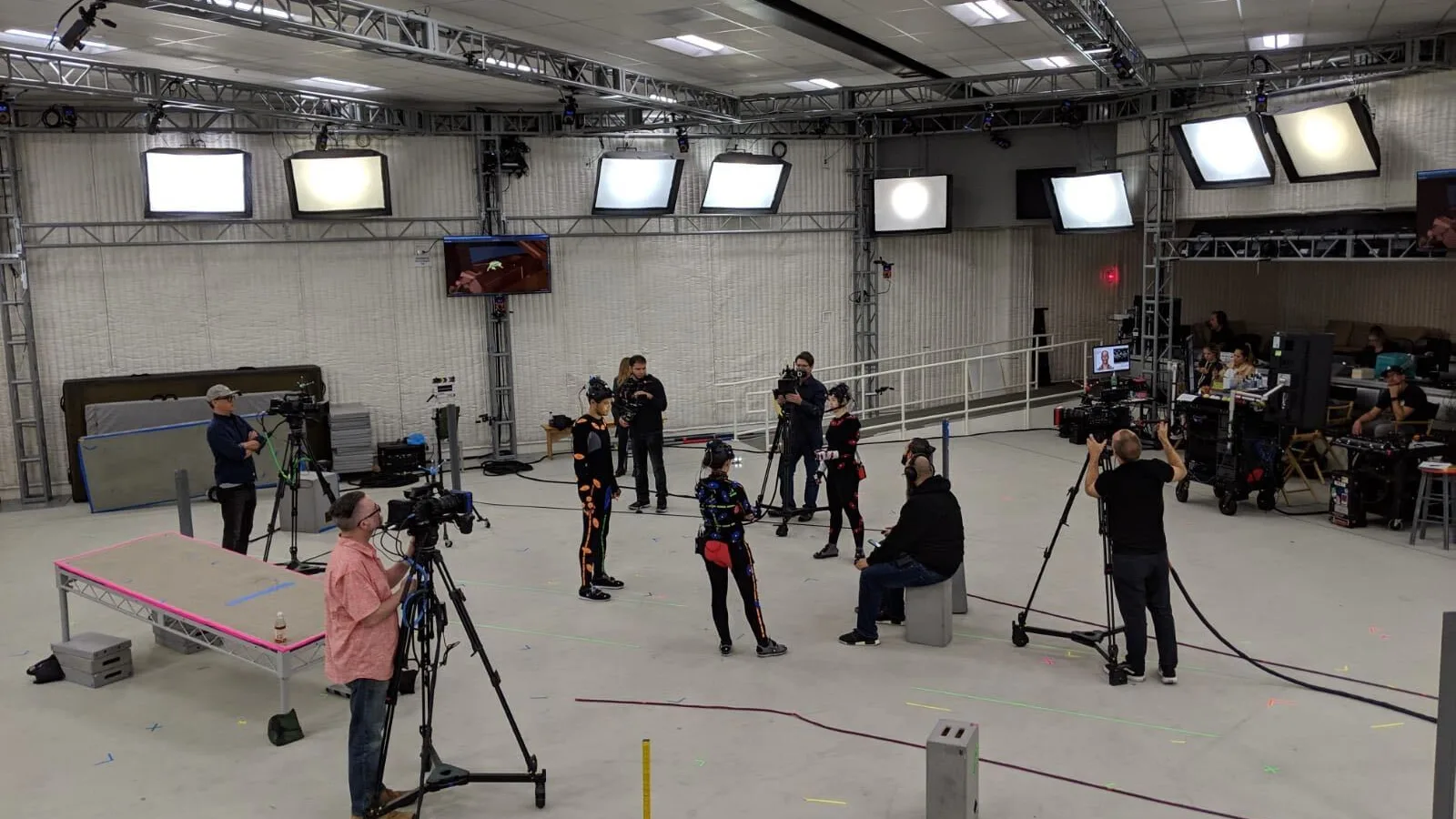
Image: “The Last of Us Part II motion capture 1” by Sam White, via source. Licensed CC BY-SA 4.0.
Tell us what you are making.
We cover VFX, 3D animation, live visuals, interactive installations and licensed drone work under one roof, at budgets from small one-off jobs upward. Send a brief and you get a real answer within 48 hours.